Data center power infrastructure is one of the most critical components of modern enterprise IT environments. Businesses depend on reliable electrical systems to keep servers, storage platforms, networking equipment, and other digital infrastructure operating continuously.
As data center workloads increase, power requirements are becoming more demanding. Enterprise applications, cloud computing, artificial intelligence, and high-performance computing require electrical infrastructure capable of delivering stable power while supporting equipment expansion and operational reliability.
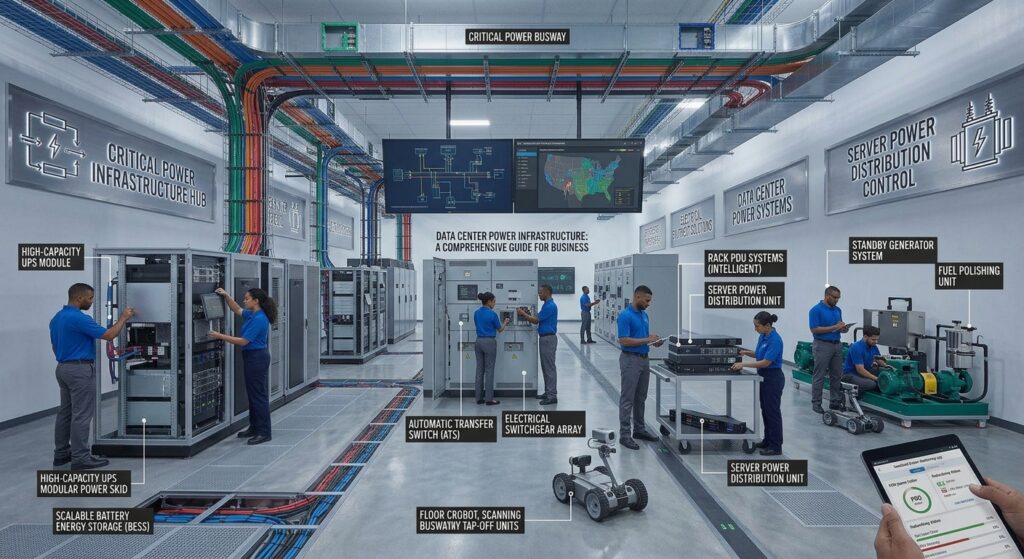
A complete data center power system includes more than an uninterruptible power supply (UPS). It may involve utility connections, transformers, switchgear, backup generators, automatic transfer switches, power distribution units, rack PDUs, battery systems, and electrical monitoring equipment.
Choosing the right data center electrical equipment requires evaluating load requirements, power protection, distribution architecture, redundancy, energy efficiency, and long-term maintenance costs.
For IT managers, facility operators, and procurement specialists, understanding these components makes it easier to compare critical power infrastructure solutions and develop a reliable data center environment.
What Is Data Center Power Infrastructure?
Data center power infrastructure refers to the electrical systems and equipment responsible for receiving, protecting, distributing, monitoring, and maintaining electrical power throughout a data center.
These systems support the continuous operation of IT equipment and the facility infrastructure required to operate it.
A typical enterprise data center power system may include:
- Utility electrical service
- Transformers
- Medium-voltage and low-voltage switchgear
- Electrical switchboards
- Circuit breakers and protective devices
- Uninterruptible power supply systems
- Battery energy storage
- Backup generators
- Automatic transfer switches
- Power distribution units
- Remote power panels
- Busway and busduct systems
- Rack power distribution units
- Power monitoring equipment
- Grounding and bonding infrastructure
Each component performs a specific function within the overall power delivery architecture.
Utility power provides the primary electrical source. Switchgear and transformers support electrical distribution. UPS systems provide conditioned power and battery-backed continuity. Generators can provide backup or alternative power sources, while distribution equipment delivers electricity to individual server racks.
The effectiveness of critical power infrastructure depends on how these components are designed, coordinated, monitored, and maintained.
How Data Center Power Systems Work
Data center power systems use multiple stages to deliver electrical power from the facility’s incoming supply to individual IT devices.
A simplified architecture includes the following stages:
- Utility electrical supply or another primary power source.
- Transformers and electrical distribution equipment.
- Main switchgear and protective devices.
- UPS systems and associated energy storage.
- Power distribution units and remote power panels.
- Overhead busway or other electrical distribution pathways.
- Rack-mounted PDUs.
- Servers, storage systems, switches, and other IT equipment.
Backup generators and automatic transfer equipment provide alternative power arrangements according to the facility’s design.
Not every data center uses exactly the same configuration. Electrical architecture varies according to facility size, utility availability, redundancy requirements, power density, and applicable engineering standards.
The selected architecture should be designed as a coordinated system rather than as a collection of independent electrical products.
Main Components of Data Center Power Infrastructure
Understanding the main equipment categories is important when comparing data center power solutions.
1. Transformers
Transformers are used to change electrical voltage levels to match different distribution requirements.
Data centers may use transformers between utility supply systems and facility distribution equipment.
Important transformer specifications include:
- Rated capacity
- Voltage ratings
- Phase configuration
- Frequency
- Impedance
- Efficiency
- Cooling design
- Installation environment
- Monitoring capabilities
The appropriate transformer configuration depends on the incoming utility service and the electrical design of the facility.
Businesses should review transformer specifications alongside the switchgear, distribution equipment, and expected electrical loads.
2. Electrical Switchgear
Switchgear is a major component of data center electrical infrastructure.
It contains switching, isolation, protection, and control equipment used to manage electrical distribution.
Depending on the installation, data center switchgear may include:
- Circuit breakers
- Protective relays
- Disconnect switches
- Metering equipment
- Control systems
- Busbars
- Electrical monitoring devices
Switchgear supports controlled electrical distribution and helps isolate equipment during certain fault and maintenance conditions.
Important buying considerations include:
- Rated voltage
- Continuous current capacity
- Short-circuit withstand capability
- Circuit breaker specifications
- Protection coordination
- Monitoring and control features
- Environmental ratings
- Maintenance requirements
Switchgear selection must be based on the complete electrical system design.
Its ratings and protective functions should be reviewed by qualified electrical engineers and other relevant professionals.
3. Electrical Switchboards and Panelboards
Switchboards and panelboards distribute electrical power to different facility loads.
In data center environments, they can support electrical distribution to UPS systems, cooling equipment, mechanical systems, lighting, and other infrastructure.
Important features include:
- Voltage and current ratings
- Circuit configuration
- Protective devices
- Metering
- Available circuit positions
- Enclosure design
- Monitoring integration
- Expansion provisions
Buyers should distinguish between the functions of switchgear, switchboards, and panelboards because their construction, application, and ratings can differ.
4. Uninterruptible Power Supply (UPS)
UPS systems provide power conditioning and temporary battery-backed power for connected equipment.
They are among the most important components of critical power infrastructure because they help protect IT equipment against certain electrical disturbances and interruptions.
When utility power becomes unavailable, a UPS can provide temporary power while the backup power architecture responds or equipment performs an appropriate shutdown.
Common UPS technologies include:
Standby UPS
Standby systems provide basic power protection for suitable equipment.
They are generally associated with smaller applications rather than large enterprise data center installations.
Line-Interactive UPS
Line-interactive systems provide power conditioning and battery-backed operation for supported applications.
They are commonly used in smaller network and IT environments.
Online Double-Conversion UPS
Online double-conversion systems continuously convert incoming power into regulated electrical output through their conversion architecture.
They are widely considered for critical IT environments that require controlled power delivery.
Modular UPS Systems
Modular UPS platforms use multiple power modules within a shared system architecture.
Depending on the platform, this design can support flexible capacity expansion and redundant module configurations.
Important UPS specifications include:
- Rated capacity in kW and kVA
- Input and output voltage
- Phase configuration
- Power factor
- Efficiency
- Battery chemistry
- Battery runtime
- Redundant configuration
- Maintenance bypass provisions
- Monitoring and management capabilities
UPS selection should be based on the actual protected load, expected expansion, required runtime, and system architecture.
A larger UPS rating does not automatically mean a better solution if the configuration is poorly matched to the facility.
5. UPS Battery Systems
Batteries provide stored energy for UPS operation during electrical interruptions.
Common battery technologies used in data center environments include:
- Valve-Regulated Lead-Acid (VRLA)
- Lithium-ion
- Other supported industrial battery technologies
Each battery technology has different characteristics involving weight, footprint, maintenance, service life, monitoring, and operating conditions.
VRLA Batteries
VRLA batteries are commonly used in UPS applications.
They provide a well-established battery option but require appropriate environmental management and lifecycle monitoring.
Lithium-Ion Batteries
Lithium-ion batteries are available in certain modern UPS platforms.
They can offer reduced footprint and different lifecycle characteristics compared with traditional VRLA installations.
However, battery management, safety requirements, operating conditions, and manufacturer compatibility must be evaluated.
Important battery specifications include:
- Supported capacity
- Runtime at the expected load
- Battery chemistry
- Expected service life
- Environmental requirements
- Battery monitoring
- Replacement requirements
- Manufacturer support
Battery sizing and integration should be performed by qualified professionals using the UPS manufacturer’s approved configurations.
6. Backup Generators
Backup generators provide an alternative electrical supply when the primary utility source is unavailable.
They are an important part of many enterprise data center power systems.
Common generator technologies include:
- Diesel generator sets
- Natural gas generator sets
- Other approved engine-generator systems
Generator systems may also be integrated into larger microgrid or onsite power architectures.
Important purchasing considerations include:
- Rated standby or prime power
- Voltage
- Frequency
- Engine configuration
- Fuel availability
- Load response characteristics
- Cooling system
- Exhaust requirements
- Noise levels
- Monitoring and control
- Maintenance and service coverage
A generator must be evaluated according to the expected facility load and the complete electrical system requirements.
Its suitability depends on more than the advertised generator output.
Fuel supply, starting reliability, emissions requirements, environmental restrictions, maintenance, and transfer arrangements must also be considered.
7. Automatic Transfer Switches (ATS)
An automatic transfer switch manages the transition between supported power sources.
In a typical backup power arrangement, an ATS can transfer an electrical load from a primary source to an alternative source when the system detects an appropriate power condition.
Depending on the electrical design, the alternative source may be a generator or another approved supply.
Important ATS specifications include:
- Voltage rating
- Current rating
- Number of poles
- Transfer configuration
- Switching capabilities
- Monitoring
- Control functions
- Short-circuit ratings
- Compatibility with the connected equipment
Transfer equipment must be selected according to the system’s source arrangement and electrical protection requirements.
The transfer process should be coordinated with the generator and UPS design.
8. Static Transfer Switches (STS)
Static transfer switches provide rapid transfer between supported electrical sources.
They are used in certain critical power architectures where equipment requires access to alternative power sources.
Some STS configurations can support single-corded IT equipment by providing access to two independent electrical feeds.
Important evaluation criteria include:
- Supported input sources
- Voltage and current ratings
- Transfer characteristics
- Power quality requirements
- Monitoring
- Redundancy architecture
- Compatibility with connected loads
An STS is not a replacement for a complete redundant electrical distribution system. It is one component within a broader power architecture.
9. Power Distribution Units (PDUs)
Power distribution units distribute electrical power from upstream equipment to different parts of a data center.
Data center PDUs may be installed as floor-standing cabinets, wall-mounted units, or other distribution enclosures.
They help distribute electrical power from UPS systems to IT equipment areas.
Important specifications include:
- Input voltage
- Output voltage
- Current capacity
- Circuit configuration
- Number of outputs
- Transformer options
- Branch circuit monitoring
- Redundancy provisions
- Installation format
PDUs should be selected according to the electrical distribution architecture and the requirements of connected equipment.
10. Rack PDU Systems
Rack PDU systems distribute electricity to servers, storage devices, switches, and other equipment within individual server cabinets.
They are a final power distribution point within many data center architectures.
Rack PDUs are available in multiple configurations.
Basic Rack PDUs
Provide electrical outlets for connected rack equipment.
Metered Rack PDUs
Provide information about electrical consumption at the PDU level.
Monitored Rack PDUs
Allow administrators to monitor electrical conditions remotely.
Switched Rack PDUs
Provide remote outlet control, depending on the model.
Some advanced systems also support outlet-level metering, environmental sensors, and power event notifications.
Important rack PDU specifications include:
- Input voltage
- Current rating
- Number of outlets
- Outlet types
- Power capacity
- Metering capabilities
- Remote management
- Outlet switching
- Rack mounting format
A rack PDU must be compatible with the electrical characteristics and connector requirements of the rack installation.
11. Remote Power Panels (RPPs)
Remote power panels distribute electrical power to localized groups of data center racks.
They can help organize branch circuit distribution and provide monitoring or management capabilities.
RPPs may be used in conjunction with larger distribution systems and overhead busway architectures.
Important considerations include:
- Rated input capacity
- Branch circuit availability
- Metering capabilities
- Enclosure configuration
- Distribution architecture
- Monitoring
- Expansion requirements
The appropriate RPP design depends on the electrical load and facility distribution strategy.
12. Busway and Busduct Systems
Busway systems distribute electrical power through enclosed conductive busbars.
They are commonly considered in larger data centers where overhead power distribution can provide flexibility for rack layouts.
Some systems support plug-in tap-off units that allow electrical distribution points to be positioned along supported busway sections.
Potential benefits include:
- Flexible distribution layouts
- Support for changing rack arrangements
- Organized overhead power infrastructure
- Expandable distribution capacity
- Integration with electrical monitoring
Important specifications include:
- Rated current
- Voltage
- Conductor material
- Short-circuit withstand capability
- Enclosure rating
- Tap-off compatibility
- Installation environment
- Manufacturer support
Eaton’s PowerWave 2 is one example of a track-style busway solution designed for data center power distribution.
13. Grounding, Bonding and Electrical Protection
Grounding and bonding are essential parts of safe electrical infrastructure.
They contribute to electrical safety, fault management, and protection of connected equipment.
Electrical protection equipment may include:
- Circuit breakers
- Fuses
- Protective relays
- Surge protective devices
- Grounding components
- Bonding components
- Electrical monitoring equipment
These systems must be selected and integrated according to the approved electrical design and applicable requirements.
Data center electrical installation and maintenance should be handled by qualified professionals.
Data Center Power Distribution Architecture
A well-designed data center power distribution system coordinates equipment from the facility’s incoming electrical supply to individual IT loads.
The architecture may include several distribution layers.
Utility and Main Electrical Distribution
The incoming utility supply provides the primary source of electrical power.
Transformers and main switchgear form part of the electrical distribution infrastructure.
These systems support facility-level distribution and provide connections to downstream electrical equipment.
UPS and Backup Power Distribution
UPS systems provide conditioned electrical output and temporary battery-backed operation.
Backup generators provide alternative power when the primary supply is unavailable.
Transfer equipment and distribution systems coordinate these sources according to the facility design.
Floor-Level Power Distribution
Floor-standing PDUs, remote power panels, and overhead busway systems can distribute electrical power to specific data center areas.
The selected approach depends on rack placement, load density, expansion requirements, and maintenance considerations.
Rack-Level Power Distribution
Rack PDU systems deliver electrical power to individual servers, storage devices, and networking equipment.
For critical systems, rack power distribution may include separate electrical feeds connected to different supported power paths.
A dual-feed arrangement is useful only when the upstream infrastructure actually provides sufficiently independent paths.
Understanding Rack PDU Systems for Critical Infrastructure
Rack PDU systems are important because they provide the final connection between data center power distribution infrastructure and installed IT equipment.
Choosing the correct rack PDU requires reviewing the entire electrical environment.
Basic vs. Intelligent Rack PDUs
Basic PDUs provide electrical distribution through multiple outlets.
Intelligent rack PDU systems can provide additional capabilities such as:
- Remote power monitoring
- Outlet-level measurement
- Remote outlet control
- Energy consumption reporting
- Temperature monitoring
- Humidity monitoring
- Network management integration
These capabilities can improve infrastructure visibility and help administrators identify abnormal power conditions.
Metered vs. Monitored vs. Switched PDUs
| PDU Type | Primary Function |
|---|---|
| Basic | Distributes power |
| Metered | Displays electrical usage |
| Monitored | Provides remote power monitoring |
| Switched | Provides remote outlet switching |
| Advanced Monitored | Provides more detailed outlet-level monitoring |
Features vary by manufacturer and product family.
Organizations should compare the exact functionality, networking capabilities, supported outlet configurations, and licensing requirements before purchasing.
ENERGY STAR also explains how intelligent PDUs can help operators identify power consumption patterns, improve capacity planning, and monitor connected equipment.
Critical Power Infrastructure and Redundancy
Redundancy is an important consideration when designing critical power infrastructure.
It provides alternative components or distribution capacity to support continued operation during certain equipment failures or maintenance activities.
Common redundancy configurations include N, N+1, and 2N.
N Configuration
N represents the capacity required to support the intended electrical load.
A system designed with N capacity does not necessarily include additional equivalent reserve capacity.
N+1 Configuration
N+1 includes the required capacity plus one additional component or unit.
Depending on the architecture, this can provide additional protection against certain component failures and support maintenance activities.
2N Configuration
2N uses two independent systems, each designed to support the required load.
This architecture can provide greater power path separation and additional resilience when correctly implemented.
A and B Power Distribution
Some data centers provide two separate electrical feeds to supported server equipment.
These are commonly referred to as A and B power paths.
Servers with dual power supplies may connect to separate paths to reduce dependence on a single power distribution route.
However, the resilience of an A/B arrangement depends on the independence of the upstream electrical systems.
A pair of rack PDUs connected to the same single-source infrastructure does not automatically provide full power-path redundancy.
Choosing the Appropriate Redundancy Level
The appropriate configuration depends on:
- Application criticality
- Required availability
- Maintenance requirements
- Infrastructure budget
- Facility architecture
- Operational risk
- Recovery requirements
Redundancy should be evaluated at the complete system level rather than by looking at individual components.
How to Select the Right Data Center Power Systems
Selecting data center power systems requires a coordinated evaluation of electrical requirements, equipment specifications, and business objectives.
The following considerations can help organizations compare available products.
Step 1: Identify the IT Load
Determine the expected power demand of the servers, storage systems, networking devices, and other IT equipment.
Consider current demand and planned infrastructure growth.
High-density GPU and AI environments may have substantially different power requirements from conventional enterprise server deployments.
Step 2: Define Power Protection Requirements
Determine which equipment requires UPS protection and what level of power continuity is required.
Review application criticality, acceptable interruption periods, and supported shutdown procedures.
Step 3: Evaluate UPS Architecture
Compare UPS technology, rated capacity, efficiency, battery options, redundancy, monitoring, and maintenance requirements.
Consider whether a centralized or modular UPS architecture is more appropriate for the facility.
Step 4: Review Backup Generation
Evaluate whether backup generators are required and how they integrate with the overall electrical architecture.
Consider capacity, fuel arrangements, maintenance, environmental requirements, and transfer equipment.
Step 5: Select Distribution Equipment
Review switchgear, switchboards, PDUs, RPPs, busways, and rack PDU configurations.
Ensure that the proposed equipment is compatible with the facility’s approved electrical design.
Step 6: Plan Electrical Redundancy
Evaluate N, N+1, or 2N configurations based on the business’s availability requirements.
Review the independence of electrical distribution paths and supported maintenance procedures.
Step 7: Evaluate Monitoring Capabilities
Consider metering, branch circuit monitoring, rack-level power monitoring, and integration with DCIM platforms.
Good visibility into electrical loads can support capacity planning and operational management.
Step 8: Review Safety and Compliance
Check the applicable U.S. electrical codes, product certifications, inspection requirements, and local authority requirements.
The NFPA 70 National Electrical Code is an important reference for electrical design, installation, and inspection in the United States.
The 2026 edition is the current edition published by NFPA as of November 2026, but the adopted edition and applicable amendments must be confirmed with the local authority having jurisdiction.
Electrical design, equipment installation, testing, and maintenance should be performed by appropriately qualified professionals.
Data Center Power Efficiency and Energy Management
Power efficiency is an important part of data center infrastructure planning.
Electrical distribution losses, UPS conversion losses, and inefficient infrastructure operation can increase operating expenses.
Several areas should be evaluated when comparing critical power infrastructure.
UPS Efficiency
UPS efficiency describes how effectively a UPS converts incoming electrical power into usable output power.
Efficiency can vary according to load level, operating mode, and equipment configuration.
Buyers should compare manufacturer efficiency curves under conditions that reflect expected operation.
Power Usage Effectiveness (PUE)
Power Usage Effectiveness measures the relationship between total facility energy consumption and IT equipment energy consumption.
A lower PUE generally indicates lower facility overhead relative to IT energy use.
However, PUE should not be treated as a complete measure of sustainability or operational efficiency.
It does not independently describe factors such as water consumption, carbon intensity, or the useful computing work delivered.
Electrical Monitoring
Power monitoring helps data center operators understand consumption across different infrastructure levels.
Monitoring may include:
- Utility power consumption
- UPS input and output
- Distribution panel loads
- Branch circuit loads
- Rack PDU consumption
- Outlet-level consumption
- Electrical event records
This information can help identify capacity constraints, unusual consumption, and potential efficiency improvements.
Battery Energy Storage
Some data center projects evaluate battery energy storage systems as part of broader power infrastructure strategies.
Depending on the design, energy storage may support UPS operation, energy management, and grid-interactive applications.
However, stationary battery energy storage systems require dedicated safety, fire protection, control, and facility planning.
Leading Data Center Power Infrastructure Manufacturers
Several established manufacturers provide electrical equipment for enterprise and hyperscale data centers.
The following companies offer useful starting points for a procurement comparison.
1. Schneider Electric
Schneider Electric provides data center power protection, electrical distribution, and infrastructure management technologies.
Its portfolio includes:
- Galaxy 3-phase UPS systems
- APC UPS solutions
- Electrical switchgear
- Circuit breakers
- Power distribution equipment
- Rack PDU systems
- Power monitoring
- EcoStruxure IT management
Galaxy UPS Portfolio
Schneider Electric’s Galaxy range includes UPS platforms designed for different data center sizes and power requirements.
Product examples include:
- Galaxy VS
- Galaxy VL
- Galaxy VX
- Galaxy VXL
These platforms differ in their capacity ranges, architecture, redundancy options, and intended deployment environments.
Evaluation considerations:
- UPS capacity
- Modular configuration
- Battery compatibility
- Operating efficiency
- Redundancy
- Power monitoring
- Service support
Official website:
2. Vertiv
Vertiv provides critical power and supporting infrastructure solutions for enterprise data centers and other mission-critical environments.
Its portfolio includes:
- Liebert UPS systems
- Power distribution equipment
- Rack PDUs
- Static transfer switches
- Switchgear and switchboards
- Busway systems
- Battery solutions
- Power monitoring technologies
Liebert UPS Systems
Liebert is a Vertiv brand associated with power and thermal management solutions.
Its product range includes UPS technologies for IT environments and larger data center applications.
Evaluation considerations:
- Power system capacity
- UPS topology
- Battery configuration
- Distribution architecture
- Monitoring and management
- System maintenance
- Enterprise support
Official website:
3. Eaton
Eaton provides electrical equipment and power management technologies for data center infrastructure.
Its portfolio includes:
- Eaton 93PM UPS
- Three-phase UPS platforms
- Automatic transfer switches
- Low-voltage switchgear
- Busway systems
- Rack PDUs
- Power distribution equipment
- Electrical monitoring solutions
Eaton 93PM UPS
The Eaton 93PM is a three-phase UPS platform designed for modern data centers and other critical environments.
Its product options include battery configurations and integrated accessories that can be evaluated according to installation requirements.
PowerWave 2 Busway
Eaton’s PowerWave 2 provides an overhead busway distribution option for supported data center and industrial applications.
Evaluation considerations:
- Electrical capacity
- Battery technology
- Distribution integration
- PDU compatibility
- Busway architecture
- Monitoring functionality
- Maintenance and support
Official website:
4. ABB
ABB provides electrical power distribution equipment for large commercial and industrial facilities, including data centers.
Its portfolio includes:
- Medium-voltage switchgear
- Low-voltage switchgear
- Transformers
- Circuit breakers
- Busway
- Automatic transfer switches
- Remote power panels
- Electrical monitoring
- Modular electrical systems
ABB solutions can be evaluated for facility-level electrical distribution and integrated critical power architectures.
Evaluation considerations:
- Voltage ratings
- Switchgear configuration
- Protection capabilities
- Power distribution topology
- Monitoring
- System integration
- Maintenance support
Official website:
5. Cummins
Cummins provides power generation equipment used in data centers and other critical infrastructure environments.
Its portfolio includes generator sets, power generation systems, and related control technologies.
Common evaluation areas include:
- Generator output capacity
- Standby and prime power ratings
- Diesel or natural gas configurations
- Engine performance
- Load response
- Fuel infrastructure
- Generator controls
- Maintenance support
Cummins has also announced natural gas generator deployments for large-scale data center power projects in the United States, reflecting growing interest in alternative and onsite power strategies.
Official website:
Data Center Power Infrastructure Manufacturer Comparison
| Manufacturer | Main Equipment | Primary Evaluation Focus |
|---|---|---|
| Schneider Electric | Galaxy UPS, switchgear, PDUs | Integrated power distribution |
| Vertiv | Liebert UPS, rack PDUs, busway | Critical power infrastructure |
| Eaton | 93PM UPS, PowerWave busway, switchgear | Electrical distribution and protection |
| ABB | Switchgear, transformers, busway | Facility-level electrical infrastructure |
| Cummins | Generator sets and controls | Backup and onsite power generation |
These manufacturers operate in different product categories and should not be compared as direct substitutes.
A complete data center project may use equipment from several manufacturers based on technical compatibility, engineering requirements, support, and procurement objectives.
Total Cost of Ownership for Data Center Power Infrastructure
Total cost of ownership (TCO) includes the expenses associated with acquiring, installing, operating, maintaining, and upgrading power infrastructure.
Important cost categories include:
| Cost Category | Items to Evaluate |
|---|---|
| UPS Systems | UPS units, modules and accessories |
| Batteries | Battery cabinets, monitoring and replacements |
| Generators | Generator sets and fuel infrastructure |
| Switchgear | Electrical distribution and protection |
| Transformers | Voltage conversion equipment |
| PDUs | Floor and rack power distribution |
| Busway | Overhead distribution infrastructure |
| Monitoring | Energy metering and management software |
| Installation | Engineering and professional services |
| Electricity | Facility power consumption |
| Maintenance | Inspection, testing and servicing |
| Expansion | Additional power capacity and distribution |
Battery replacement, generator maintenance, UPS servicing, and electrical equipment upgrades can contribute significantly to lifecycle expenses.
Organizations should compare equipment purchase prices with expected operating costs and infrastructure service requirements.
Common Mistakes When Purchasing Data Center Electrical Equipment
Selecting data center electrical equipment without evaluating the complete power architecture can create operational and financial problems.
1. Selecting UPS Capacity Without Reviewing the Actual Load
UPS selection should be based on the expected protected load, expansion requirements, and manufacturer specifications.
A nominal capacity rating alone does not establish system suitability.
2. Ignoring Generator Integration
Backup generators must be evaluated as part of the complete power architecture, including transfer equipment, fuel arrangements, maintenance, and UPS coordination.
3. Underestimating Rack Power Density
Modern GPU and high-performance servers can require more electrical capacity per rack than conventional server configurations.
Rack-level planning is therefore important.
4. Overlooking Power Distribution Losses
Transformers, UPS systems, and other electrical distribution equipment consume energy.
These losses should be considered when comparing overall system efficiency.
5. Treating Redundancy as a Label
An N+1 or 2N specification does not automatically guarantee a particular availability outcome.
The independence of distribution paths and actual facility design must be reviewed.
6. Ignoring Battery Lifecycle Requirements
UPS batteries require appropriate monitoring, maintenance, and planned replacement.
Battery chemistry and service conditions can affect overall ownership costs.
7. Selecting Rack PDUs Without Checking Compatibility
Voltage, current, connector type, outlet count, and load requirements must be reviewed before choosing a rack PDU.
8. Ignoring Electrical Compliance and Safety
Electrical equipment must be selected and installed according to applicable codes, manufacturer requirements, and the facility’s approved engineering design.
Conclusion
Data center power infrastructure provides the electrical foundation for reliable enterprise computing environments.
A complete critical power architecture may include utility connections, transformers, switchgear, UPS systems, battery storage, backup generators, transfer switches, PDUs, busway, and rack PDU systems.
The right data center power solution depends on expected electrical loads, power quality requirements, availability targets, distribution architecture, energy efficiency, and long-term operating expenses.
Schneider Electric, Vertiv, Eaton, ABB, and Cummins provide different technologies that can form part of an enterprise data center power infrastructure project.
Businesses should compare the complete electrical architecture rather than selecting individual equipment based only on advertised capacity or product price.
By evaluating power protection, distribution, redundancy, monitoring, efficiency, and lifecycle costs, organizations can develop critical power infrastructure capable of supporting present computing requirements and future data center expansion.
Frequently Asked Questions
1. What is data center power infrastructure?
Data center power infrastructure refers to the electrical equipment and systems responsible for receiving, protecting, distributing, monitoring, and maintaining electricity throughout a data center.
2. What are the main components of a data center power system?
Common components include utility electrical service, transformers, switchgear, UPS systems, batteries, generators, automatic transfer switches, PDUs, busway, and rack PDU systems.
3. What is the purpose of a UPS in a data center?
A UPS provides power conditioning and temporary battery-backed power for connected equipment during certain electrical disturbances and interruptions.
4. What is the difference between UPS and backup generators?
A UPS provides conditioned power and temporary energy storage. A backup generator provides an alternative electrical source for longer-duration operation when the primary power supply is unavailable.
5. What is a rack PDU system?
A rack PDU system distributes electrical power from upstream distribution equipment to servers, storage systems, network switches, and other devices inside a rack.
6. What is the difference between a rack PDU and a floor-standing PDU?
A rack PDU distributes power to equipment within an individual cabinet. A floor-standing PDU provides distribution to broader equipment areas or rack groups, depending on the facility design.
7. What is the difference between N+1 and 2N power redundancy?
N+1 provides the required capacity plus one additional component. 2N uses two independent systems, each designed to support the required load.
8. What is a static transfer switch?
A static transfer switch transfers supported electrical loads between alternative power sources using electronic switching technology.
9. What is a remote power panel?
A remote power panel is an electrical distribution enclosure that supplies power to localized data center areas or groups of equipment.
10. What is data center busway?
Busway is an enclosed electrical distribution system using conductive busbars to distribute power across facility areas. Certain designs support adjustable tap-off connections.
11. How do businesses choose a data center UPS?
Important considerations include expected electrical load, capacity, input and output voltage, phase configuration, power factor, efficiency, battery runtime, redundancy, monitoring, and maintenance requirements.
12. Which companies manufacture data center power systems?
Schneider Electric, Vertiv, Eaton, and ABB provide various UPS, switchgear, distribution, and power management solutions. Cummins provides generator systems used in critical infrastructure.
13. What is PUE in data centers?
Power Usage Effectiveness measures total data center facility energy consumption relative to the energy used by IT equipment. It is commonly used to evaluate facility energy overhead.
14. What electrical standards apply to data center power infrastructure in the United States?
NFPA 70, the National Electrical Code, is a major reference for electrical design, installation, and inspection. The applicable adopted edition, local amendments, and requirements of the authority having jurisdiction must be verified for each project.
Sources and References
- ENERGY STAR – Reduce Energy Losses from Power Distribution Units (PDUs)
https://www.energystar.gov/products/data_center_equipment/16-more-ways-cut-energy-waste-data-center/reduce-energy-losses-power-distribution-units-pdus - Uptime Institute – Tier Classification System
https://uptimeinstitute.com/tiers - Uptime Institute – Tier Certification
https://uptimeinstitute.com/tier-certification/ - U.S. Department of Energy – Best Practices Guide for Energy-Efficient Data Center Design
https://www.energy.gov/cmei/femp/articles/best-practices-guide-energy-efficient-data-center-design - ASHRAE – AI Data Center Energy Performance Framework
https://www.ashrae.org/technical-resources/topics-and-initiatives/ai-data-center - NEMA – Data Center Electrical Technology and Standards Map
https://www.makeitelectric.org/infrastructure/data-center-map/ - NFPA – NFPA 70 National Electrical Code
https://www.nfpa.org/en/Codes-and-Standards/Document-information-pages/70 - Schneider Electric – Data Center and Facility 3-Phase UPS
https://www.se.com/us/en/product-subcategory/8030-data-center-and-facility-3-phase-ups/ - Schneider Electric – Galaxy UPS Portfolio
https://www.se.com/ww/en/work/products/master-ranges/galaxy/ - Vertiv – Critical Power and Power Distribution
https://www.vertiv.com/en-us/products-catalog/critical-power/power-distribution/ - Vertiv – Liebert Power and Thermal Management
https://www.vertiv.com/en-us/products/trusted-names/vertiv/ - Eaton – 93PM UPS
https://www.eaton.com/us/en-us/catalog/backup-power-ups-surge-it-power-distribution/eaton-93pm-ups.html - Eaton – PowerWave 2 Busway
https://www.eaton.com/us/en-us/catalog/low-voltage-power-distribution-controls-systems/eaton-pdi-busway.html - Eaton – Data Center Power Infrastructure Solutions
https://www.eaton.com/us/en-us/markets/data-centers/infrastructure-grey-space/data-center-power-infrastructure-and-performance-optimization/grey-data-center-infrastructure-solutions.html - ABB – Data Center Power Distribution
https://new.abb.com/data-centers/powerdistribution - Cummins – Generator Solutions for Data Centers
https://www.cummins.com/generators